PIPEDA vs GDPR Key Differences for Businesses

A Canadian business can follow PIPEDA and still face GDPR duties. A local business serving Canadian customers and keeping operations domestic will usually begin with PIPEDA. Offering goods or services to people in the EU, or monitoring their behaviour, can also bring GDPR into scope, even without a European office. The Government of Canada's GDPR guidance explains this broader territorial reach.
Email operations make the overlap practical. A newsletter list, support inbox, customer database, and campaign archive hold personal information. Consent records, retention settings, access-request procedures, vendor contracts, and breach workflows should reflect every applicable rule. For Canadian small businesses, that may also mean checking whether EU transfers remain permitted and keeping email data under Canadian jurisdiction with Typewire.
This PIPEDA vs GDPR comparison focuses on those operating choices, not just different fine levels.
Quick comparison table
A Canadian small business may start with PIPEDA for its domestic commercial activity, then add GDPR duties when it offers services to people in the EU or monitors their behaviour. The practical question is how each rule affects your email list, support mailbox, customer records, vendors, and breach plan.
| Criteria | PIPEDA | GDPR |
|---|---|---|
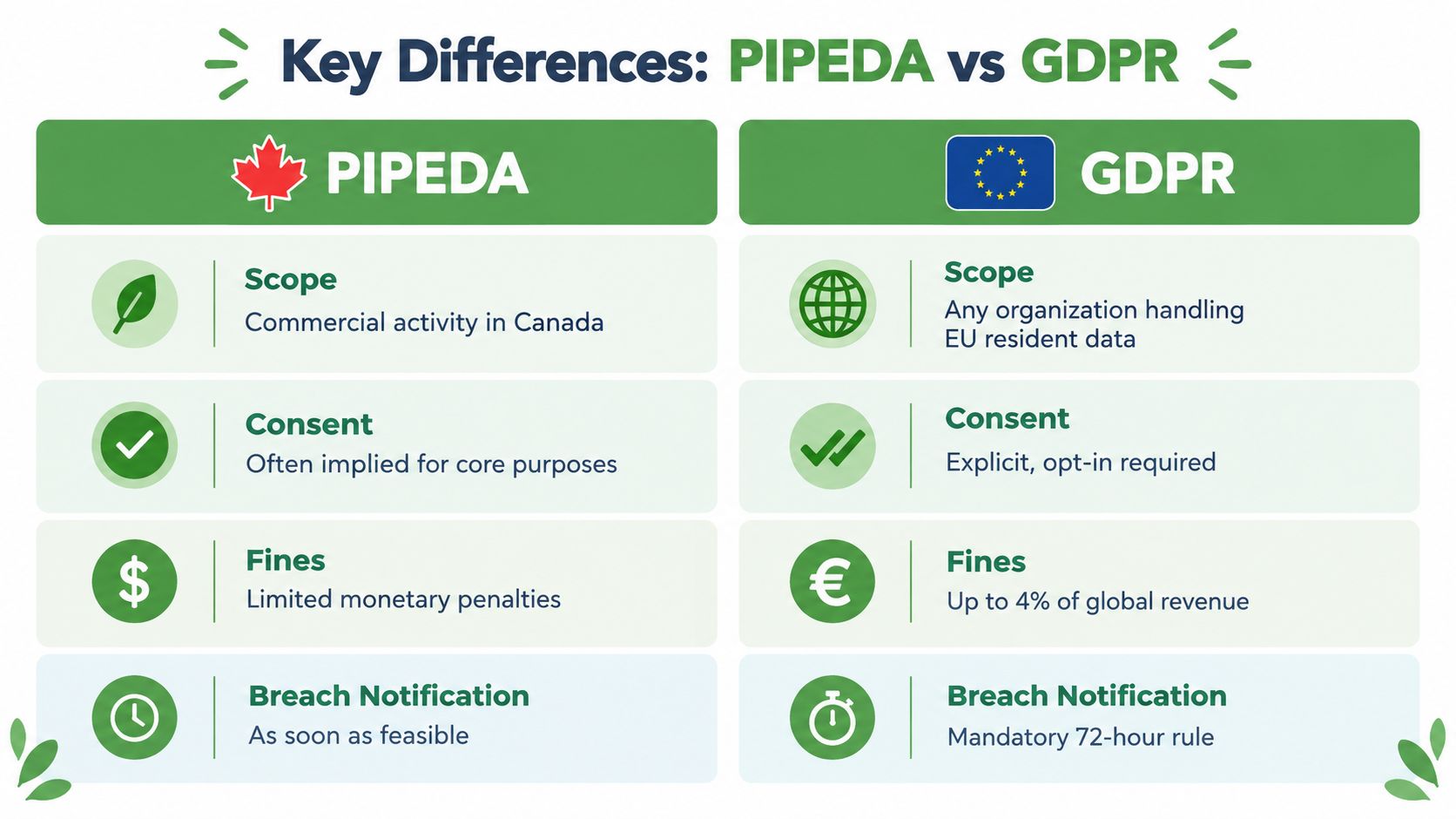
| Scope and reach | Applies to organizations across Canada that collect, use, or disclose personal information during commercial activity, subject to substantially similar provincial laws. | Applies to organizations established in the EU and to organizations outside the EU that offer goods or services to people in the EU or monitor their behaviour. |
| Core approach | Uses 10 fair information principles, including accountability, consent, limiting collection, safeguards, access, and challenging compliance. | Uses a broader rights and lawful-basis model for processing personal data. |
| Consent | Centres on meaningful consent, with limited exceptions where individual consent does not fit the situation. | Consent is one lawful basis. The EU framework can also rely on legitimate interests in appropriate circumstances. |
| Individual control | Provides access and correction rights, supported by openness and accountability obligations. | Provides a broader rights model, including access and other controls over processing. |
| Breach response | Notification to individuals is required when there is a real risk of significant harm. | Supervisory-authority notification is required without undue delay and, where feasible, within 72 hours when the breach presents a risk. See the GDPR breach timing guidance. |
| Cross-border transfers | Canadian organizations remain responsible for personal information handled through external providers. | Canada maintains adequacy status for certain PIPEDA-covered commercial transfers, but adequacy does not replace GDPR compliance. |
| Maximum penalty cited in the governing framework | The federal statute includes a penalty framework commonly described as reaching $100,000 CAD per violation. See the official PIPEDA statute. | Serious violations can reach €20 million or 4% of worldwide annual turnover, whichever is higher. See the European Data Protection Board's fine guidance. |
For email operations, the overlap is concrete. A Canadian-hosted mailbox or campaign database can help keep data under Canadian jurisdiction and simplify vendor review, including when you use Typewire. It does not settle every GDPR question. You still need to assess the audience, processing purpose, consent method, EU transfer conditions, and breach workflow.
What is PIPEDA
A Canadian business collects an email address for an order receipt, then considers adding that customer to a promotional list. The Personal Information Protection and Electronic Documents Act, or PIPEDA, asks the business to examine the purpose, consent, safeguards, and later use of that information. It is Canada's federal private-sector privacy law for personal information handled during commercial activity. That includes businesses selling products, providing services, managing customer accounts, or running commercial email programmes.
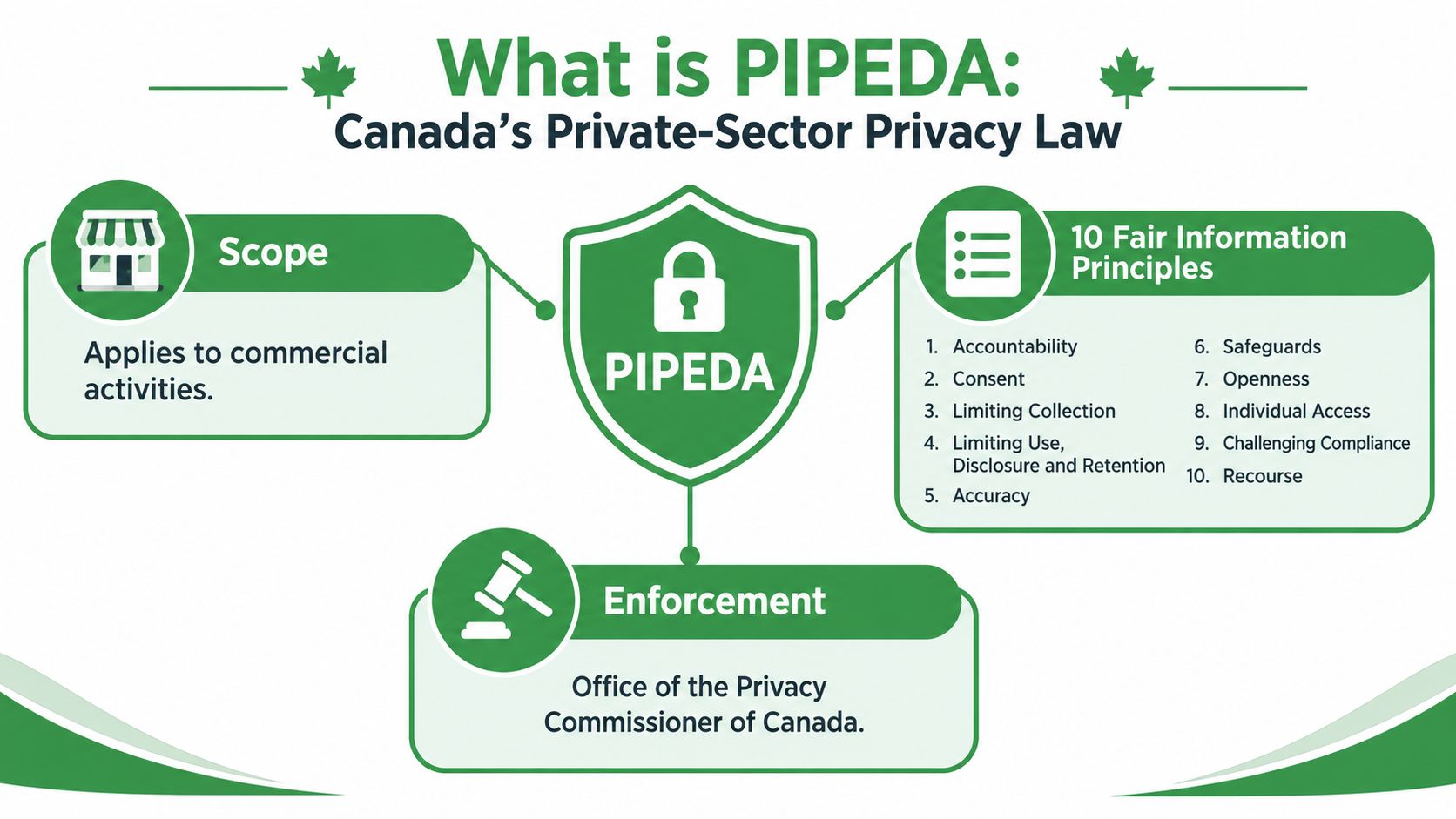
PIPEDA works less like a technical checklist and more like a set of operating rules. Its 10 fair information principles guide how an organization collects, uses, stores, and shares personal information:
- Accountability: assign responsibility for privacy within the organization.
- Identifying purposes: explain why information is being collected.
- Consent: obtain meaningful consent for collection, use, and disclosure.
- Limiting collection: collect only what the stated purpose requires.
- Limiting use, disclosure, and retention: avoid unrelated use or unnecessary retention.
- Accuracy: keep records accurate and complete.
- Safeguards: apply security appropriate to the information's sensitivity.
- Openness: describe privacy practices in plain language.
- Individual access: let people request access to their information.
- Challenging compliance: provide a process for privacy concerns.
The Office of the Privacy Commissioner of Canada's PIPEDA overview explains the principles and the law's focus on commercial activity.
Meaningful consent in daily email work
An order receipt does not automatically justify unrelated promotional messages. A sign-up form should state what messages the person will receive, why the address is needed, and whether another provider will process the data. Keeping those details with the subscription record gives your team a clearer basis for future review.
PIPEDA's consent model includes limited exceptions because some situations do not suit individual consent. The Privacy Commissioner's consent guidance explains meaningful consent and recognizes that other privacy frameworks may use different lawful bases.
Provincial context also matters. Quebec, Alberta, and British Columbia have substantially similar private-sector privacy regimes, so a business operating locally or keeping customer information within a province should account for the applicable provincial rules. PIPEDA remains a federal reference point for many organizations.
For practical steps, read this guide to PIPEDA compliance for your business. The working principle is clear: PIPEDA asks you to build accountable, understandable, and limited data practices around commercial activity.
What is GDPR
A Canadian online shop that actively serves EU buyers may need to assess the General Data Protection Regulation, or GDPR. This EU data protection framework can apply beyond organizations established in the EU when a business offers goods or services to people in the EU or monitors their behaviour.
A European visitor landing on a general website does not, by itself, settle every applicability question. Deliberate targeting, account access, advertising, or user monitoring calls for closer review. A software company tracking EU users should examine its service, while a business with no such focus may face a different analysis.
Why email teams notice the difference
GDPR treats consent as one possible lawful basis for processing, rather than the only route. That distinction matters when a Canadian business records newsletter subscriptions, sends transactional messages, handles support requests, segments contacts, or processes suppression requests.
Your team needs a clear map of its email data. Record what information you hold, why you use it, who processes it, and which lawful basis supports each activity where GDPR applies. A receipt email, a support conversation, and a promotional sequence may involve the same address but different purposes.
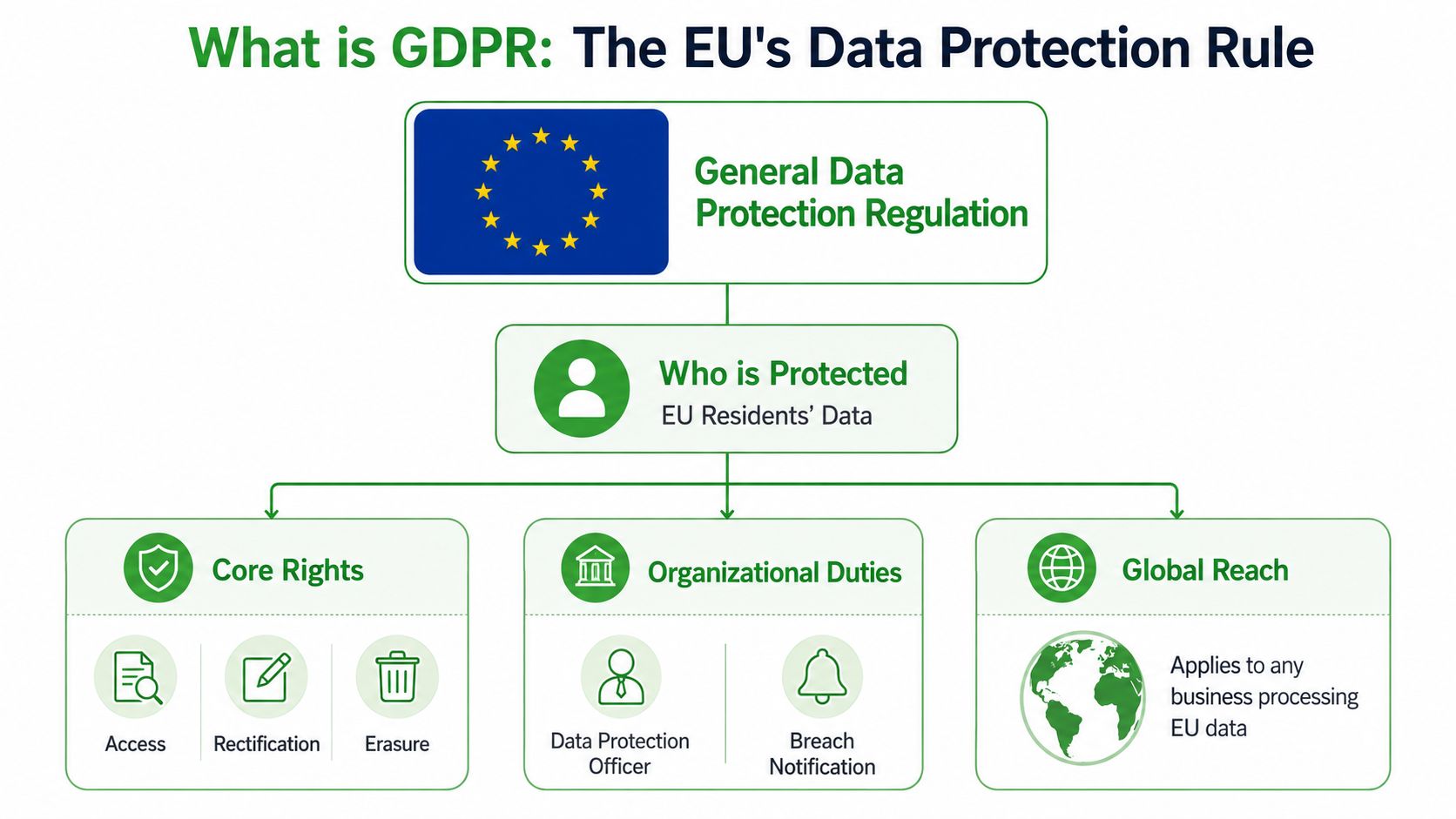
GDPR also emphasizes transparency, individual control, security, and documented accountability. These duties can affect both your business, which decides why email data is used, and the provider processing it on your behalf. A breach workflow should identify the records involved, preserve relevant logs, and route the incident for timely assessment.
A Canadian company's location does not end the analysis. Your audience and behaviour do. Typewire can help keep email data under Canadian jurisdiction through Canadian data residency, but that does not remove your responsibility to assess whether your service targets EU residents or monitors them. EU transfers and provider arrangements still require review.
Key differences that affect your business
A Canadian shop sends an order receipt, a newsletter, and a support reply to the same customer. Those messages may use one email address, but privacy rules can treat the purposes differently. The most useful PIPEDA GDPR comparison therefore focuses on daily operations, including forms, inboxes, retention, access requests, and incident response.
Consent and lawful bases
PIPEDA centres on meaningful consent for collecting, using, and disclosing personal information. Limited exceptions exist, but your business should explain its purposes clearly and collect only what it needs.
GDPR offers several lawful bases, including consent, contractual necessity, legal obligations, and legitimate interests. Legitimate interests requires more than a general business preference. You need a defensible purpose, a balancing assessment, transparent communication, and a process for applicable objections.
Practical rule: Record what a person agreed to, which message category that agreement covered, and how they can change their preference.
Separate transactional messages from marketing where your circumstances require it. An order update and a promotional sequence have different purposes. Your preference system should preserve that distinction rather than treating every address as one blanket permission.
Scope and territorial reach
PIPEDA applies to commercial activity under the federal framework, subject to exemptions where provinces have substantially similar laws. GDPR applies to organizations established in the EU and to certain organizations outside the EU that offer goods or services to people in the EU or monitor their behaviour.
A local business can begin with domestic obligations, then add GDPR duties after launching EU shipping, accepting EU subscriptions, or introducing behaviour monitoring aimed at EU users. The change comes from the business activity, not from the email platform it uses.
Rights and email records
PIPEDA gives individuals access to personal information and the ability to challenge its accuracy and completeness. Relevant records may sit in customer profiles, support systems, mailing lists, exports, and suppression records.
GDPR provides a broader rights model. Depending on the request and circumstances, your team may need to address access, correction, deletion, restriction, objection, or portability. Your email provider may not decide whether a request is legally valid, but it should help you locate, export, correct, suppress, or delete relevant data when your obligations require action.
Use one intake route for privacy requests. Train support staff to recognize requests such as “show me what you hold about me” and “stop processing my information.” A single route reduces the chance that a customer gets sent between marketing, support, and technical teams.
Breach triggers and timing
PIPEDA uses a risk-based trigger. Notify affected individuals when it is reasonable to believe a breach creates a real risk of significant harm. The federal framework also includes breach reporting and recordkeeping duties.
GDPR requires controllers to notify the supervisory authority without undue delay and, where feasible, within 72 hours after becoming aware of a breach, unless the incident is unlikely to create a risk to individuals. The GDPR breach notification reference describes that timing rule.
A breach plan should answer five questions: who detects the incident, who contains it, who assesses risk, who contacts regulators, and who communicates with affected people.
Email incidents can involve a misdirected attachment, compromised credentials, exposed exports, or a vendor failure. Your plan should preserve logs, identify affected records, document decisions, and maintain a clear timeline. For a small business, a written escalation path can prevent uncertainty from delaying a required assessment.
Cross-border transfers and enforcement
Canada maintains GDPR adequacy status for PIPEDA-covered commercial transfers. That can support certain flows of EU personal data to Canadian commercial organizations, but it does not make PIPEDA and GDPR interchangeable. Your processing duties, security controls, notices, processor arrangements, and incident procedures still require review.
Canadian data residency can help keep email data under Canadian jurisdiction and clarify vendor control. Typewire can support that arrangement through Canadian data residency, but hosting in Canada does not by itself determine whether GDPR applies. Review who your business targets, what it monitors, and where providers process the information.
Penalty structures also differ. The GDPR can impose up to €20 million or 4% of worldwide annual turnover, whichever is higher, while the PIPEDA federal framework is commonly described as reaching $100,000 CAD per violation. The scale makes documented governance, careful vendor selection, clear retention rules, and a breach workflow practical safeguards rather than paperwork.
Which law applies to you
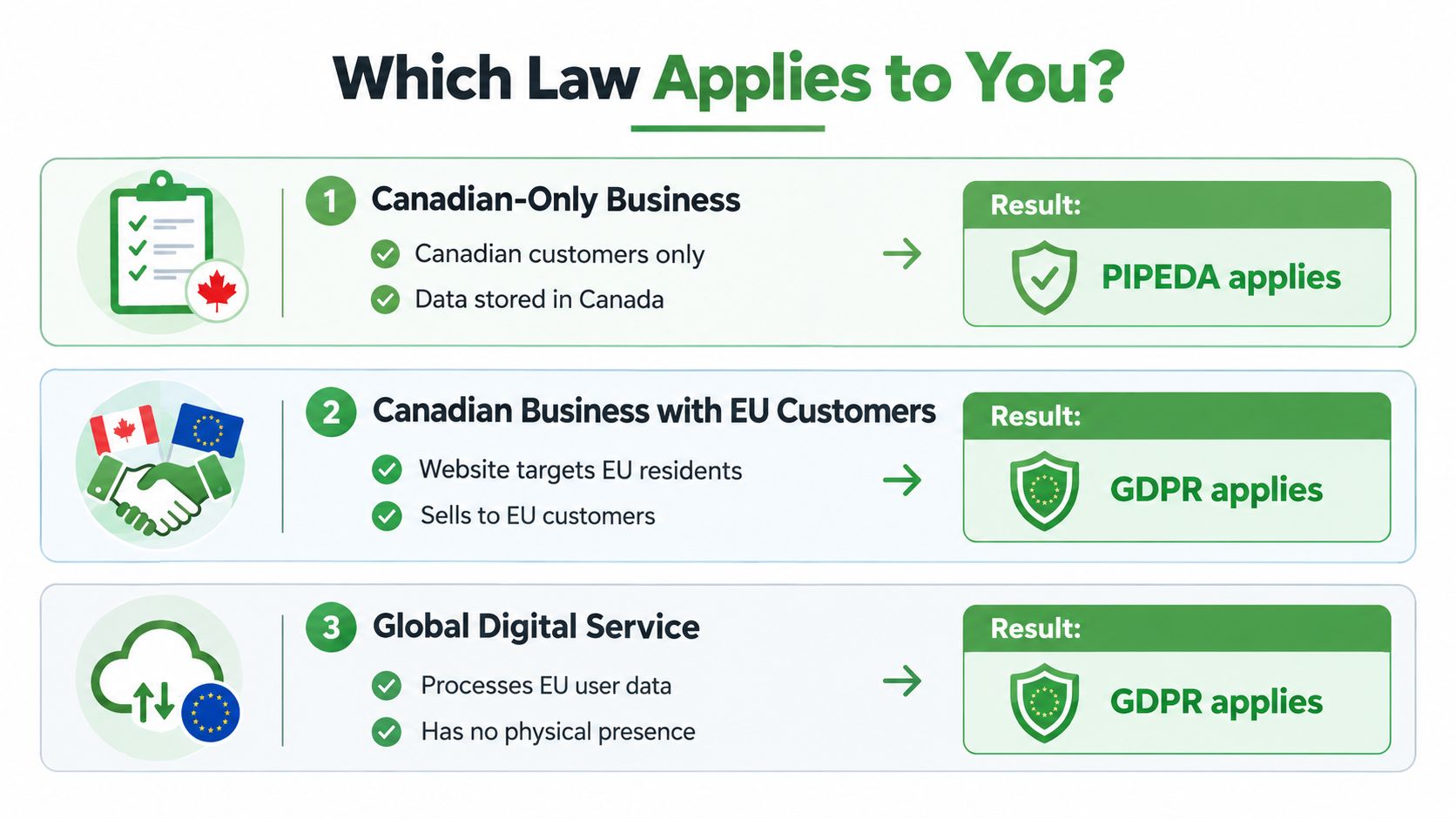
Start with your business activity, not your email server's location. Canadian hosting can support sovereignty and vendor control, but storage location alone doesn't decide whether GDPR applies.
| Your situation | Likely priority |
|---|---|
| You operate commercial activities for a domestic audience and don't target or monitor EU residents. | Start with PIPEDA or the applicable substantially similar provincial law. |
| You actively offer goods or services to EU residents. | Assess GDPR alongside your domestic obligations. |
| You monitor behaviour of people in the EU. | Assess GDPR, even if your organization has no EU office. |
| You're established in the EU and handle customer data in Canada. | GDPR applies to your EU establishment, while Canadian obligations may also arise from the Canadian activity. |
A “Canadian-only” company can still receive an occasional message from Europe without automatically becoming a GDPR-targeting business. The facts matter. Look at language, pricing, shipping options, advertising, account availability, tracking, and the choices your business makes to reach people.
A Canadian business that sells to EU customers should treat the laws as overlapping duties rather than choosing one. Review your newsletter forms, privacy notice, customer database, support inbox, processor agreements, and deletion workflow.
Canadian data residency can make one part of the assessment clearer. Canada maintains adequacy status for certain PIPEDA-covered commercial transfers, but adequacy doesn't replace breach readiness or governance. You also need awareness of substantially similar regimes in Quebec, Alberta, and British Columbia.
Our guide to Canadian data sovereignty for your 2026 business covers the hosting question in more detail. The practical decision is whether your company targets EU residents, monitors them, or handles their data through a relationship that brings GDPR into scope.
Compliance overlap and practical checklist
You don't need two completely separate privacy programmes. A well-organized baseline can support both laws, then add the extra controls your activities require.
- Assign ownership: Name the person responsible for privacy, vendor reviews, access requests, and incident decisions.
- Map email data: Record where addresses, names, message history, attachments, preferences, and exports live.
- Explain purposes: Write plain-language notices for newsletters, support, billing, account security, and analytics.
- Manage consent: Store the source, time, purpose, and scope of each marketing preference. Make withdrawal easy.
- Minimize retention: Keep only the information you need for a stated purpose. Remove stale exports and unused lists.
- Prepare access workflows: Create a repeatable process for finding mailbox content, customer records, and preference data.
- Control permissions: Use role-based access, strong authentication, encryption, phishing protection, and staff training.
- Review providers: Check where email is hosted, who can access it, what subprocessors are involved, and how deletion works.
- Test breach response: Document the PIPEDA significant-harm assessment and prepare for GDPR's 72-hour authority-notification rule where applicable.
- Keep evidence: Preserve consent records, risk assessments, vendor reviews, training notes, and incident timelines.
Hosting email in Canada can reduce uncertainty about jurisdiction and support a sovereignty-focused operating model. It doesn't remove the need to assess GDPR targeting, consent, rights, or breach duties. It also doesn't make a provider automatically compliant on your behalf.
Typewire is one Canadian option for businesses that want ad-free email hosted on privately owned infrastructure in Vancouver, with custom domains, encryption, and no data mining. We disclose our relationship because Typewire publishes this article, and you should still review any provider's terms, security practices, access controls, and contractual commitments.
For a broader task list, use this GDPR compliance checklist alongside your PIPEDA review. Then test the workflow with a mock access request and a mock email incident. A policy that staff can't follow during a busy launch won't protect your customers when something goes wrong.
If you want email kept under Canadian jurisdiction without advertising or data mining, visit Typewire to review our private Canadian-hosted email, custom-domain support, and business-focused plans. Start with the free trial, then confirm that our hosting and privacy practices fit your organization's PIPEDA and GDPR assessment.
PIPEDA vs GDPR Key Differences for Businesses
Posted: 2026-09-11
PIPEDA vs GDPR Key Differences for Businesses
Posted: 2026-09-11
CASL Express vs Implied Consent: What’s the Difference?
Posted: 2026-09-08
Moving Away from Big Tech Email and How to Make the Transition Smooth. Here’s How:
Posted: 2026-09-04
Why Choose Typewire as a Canadian Email Option
Posted: 2026-09-01
What Happens if You Open a Phishing Email?
Posted: 2026-08-28
How to Evaluate Canadian Email Hosting Providers (2026 Guide)
Posted: 2026-08-25
What Is DKIM Record and How Email Signing Works
Posted: 2026-08-21
“DMARC Policy Not Enabled”: What It Means and How to Fix It
Posted: 2026-08-18